Study on the Development and Calculation of Direct Obstetric CFR Indicators at the District/City Level
Executive Summary
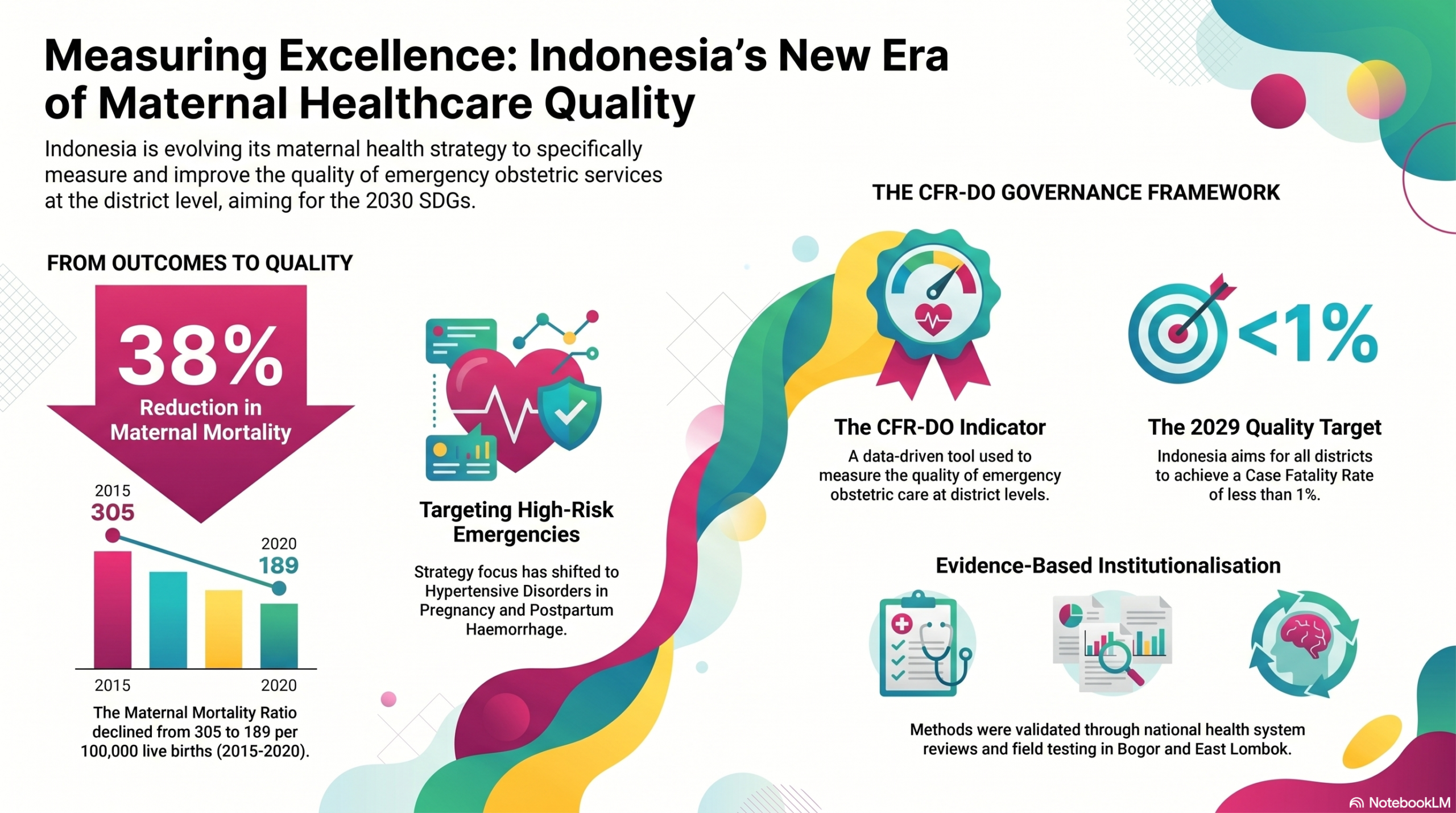
Indonesia has made significant progress in reducing the Maternal Mortality Ratio (MMR), declining from 305 per 100,000 live births in 2015 to 189 in 2020. However, achieving the SDGs 2030 and RPJP 2045 targets requires a stronger focus on the quality of emergency obstetric care. In response, the Government of Indonesia incorporated the Case Fatality Rate–Direct Obstetric (CFR-DO) indicator into the RPJMN 2025–2029 to measure service quality at district level, particularly for Hypertensive Disorders in Pregnancy (HDP) and Postpartum Hemorrhage (PPH), which account for the highest proportion of maternal deaths.
Through collaboration with Bappenas, the Ministry of Health, Ministry of Home Affairs, BPJS, UNFPA, and UNICEF, Reconstra led the development of a robust national methodology for calculating CFR-DO. Using a mixed-methods approach—combining desk review of five national health information systems, statistical simulations using E-claim and V-claim data, and field validation in Bogor and East Lombok—Reconstra identified the most reliable data source, established eligibility criteria for district-level calculation, and defined technical prerequisites for accurate estimation.
The project produced a comprehensive Final Report, Policy Brief, and operational recommendations to institutionalize automated CFR-DO monitoring nationwide. Importantly, the outputs initiated the integration of the RPJMN indicator “% districts with CFR-DO <1%,” providing Indonesia with a measurable, data-driven instrument to strengthen PONED/PONEK services and accelerate maternal mortality reduction through evidence-based governance.