Five-Year Target Determination Study and Health Adjustment Life Expectancy (HALE) Calculation
Executive Summary
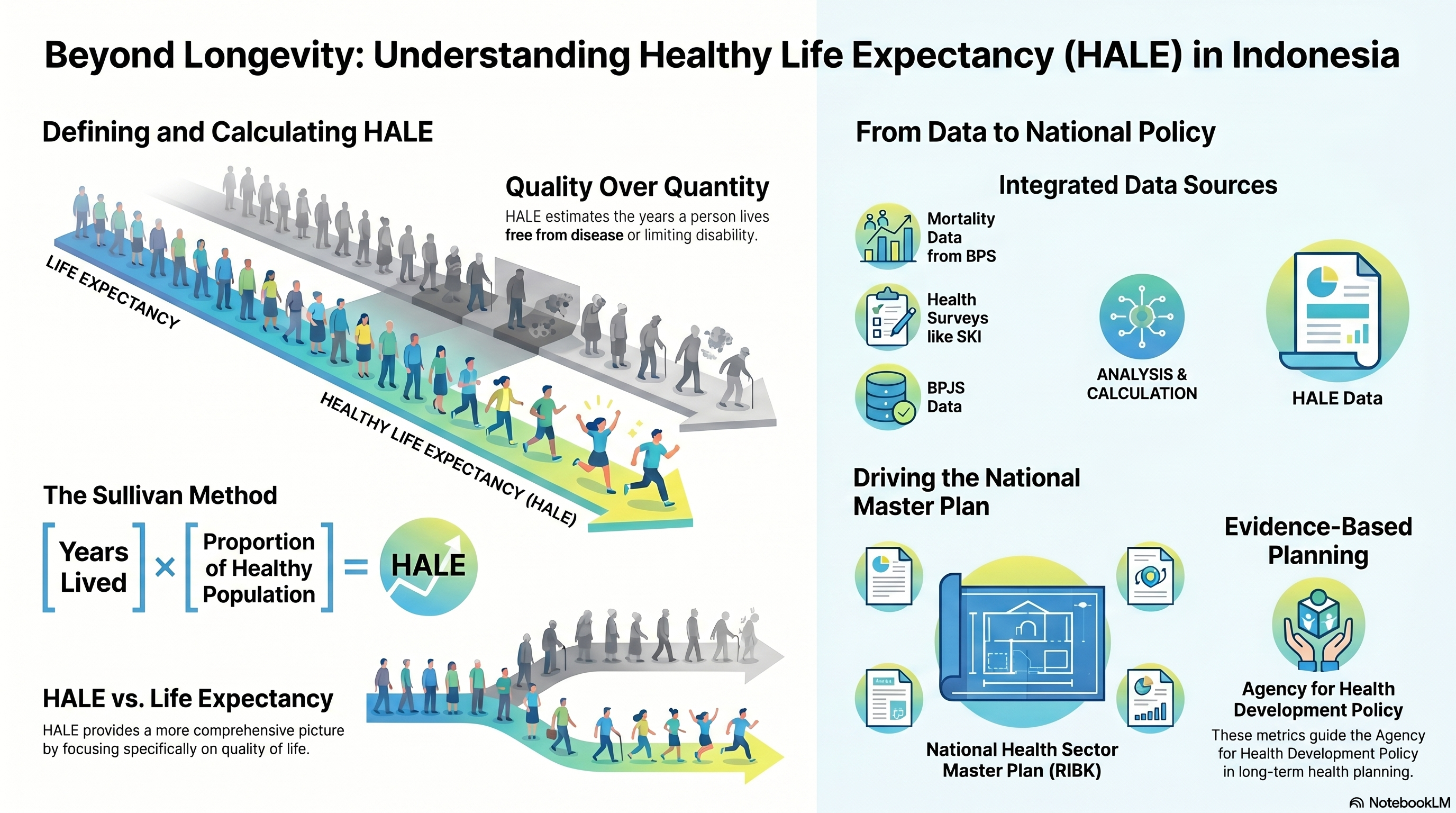
Life expectancy in Indonesia has continued to increase; however, living longer does not always mean living healthier. Healthy Life Expectancy (HALE) captures this distinction by estimating the average number of years a person can expect to live in good health, free from disease or disability that limits daily activities. Unlike overall life expectancy, HALE emphasizes quality of life and provides a more comprehensive picture of population health.
Calculating HALE in Indonesia requires two core data components from the same reference period. Mortality data are used to construct life tables and are primarily sourced from Badan Pusat Statistik. Morbidity and disability data describe the proportion of the population living in healthy and unhealthy conditions by age group, drawing on SUSENAS, the Indonesia Health Survey (SKI), and health claims data from BPJS Kesehatan.
HALE is calculated using the Sullivan method by multiplying years lived at each age by the proportion of the population in good health and summing the results across age groups. Consistency in definitions and data quality is essential, as differences across data sources can lead to varying estimates.
HALE estimates are used to support the development of the National Health Sector Master Plan (RIBK) by the Ministry of Health of the Republic of Indonesia, through the Agency for Health Development Policy, informing evidence-based medium- and long-term health policy planning.